
Equipment & Software
That was all the hardware I had. It was pretty much a no-budget project. You’ll find more information on the AI used below.
Instruments, technology (excluding AI)
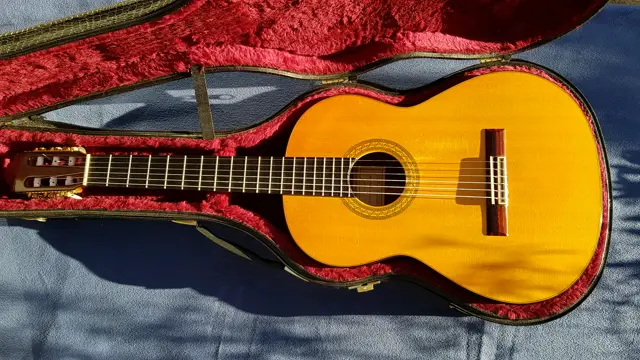
I’m grateful that, as a mediocre amateur guitarist, I’m allowed to play such a masterpiece! The Bernabé is worth many times over the rest of my kit. Modelo 40, built in 1992. That’s when I bought it, too. Recorded with two microphones, at the 12th fret (Røde NT1-A) and next to the soundhole (Røde M3), 30 cm apart. Recorded twice, so the main part is on four audio tracks. It is the only instrument that sounds exactly as it was recorded – no equaliser, no reverb, pure Bernabé.
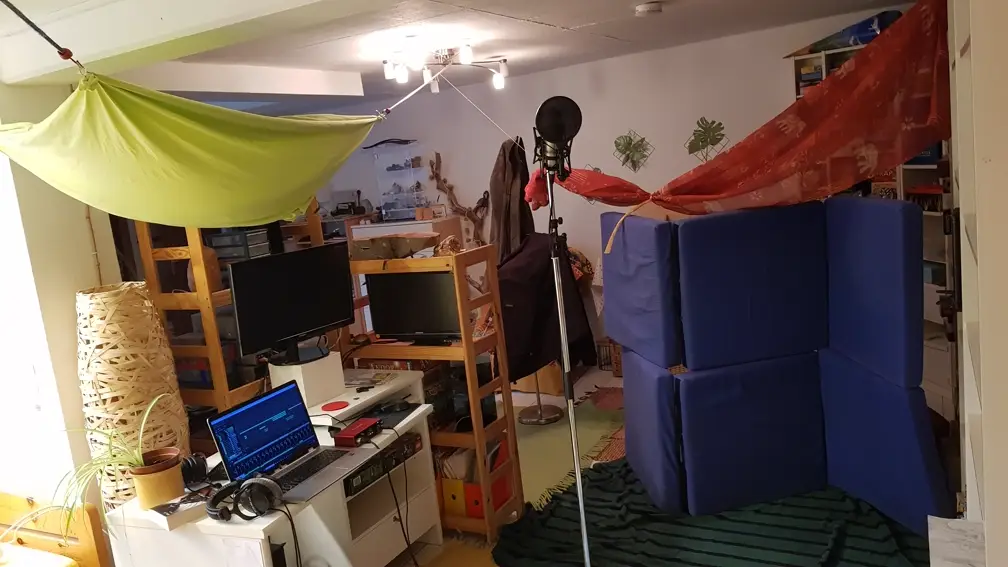
Julian’s room is furthest away from Jonas, who is sensitive to noise. That’s why my recording studio had to be here. I have his permission to make music there. But he knew nothing about my recordings. All the classical guitar and vocal parts were recorded here. I covered the tiled floor with blankets and tried to place sound-absorbing elements everywhere. The aim is to achieve as dry a sound as possible, which can then be processed specifically in the DAW. I always took photos beforehand and tidied up afterwards so that no one would notice what I’d been doing. Why? See Project BluJo.
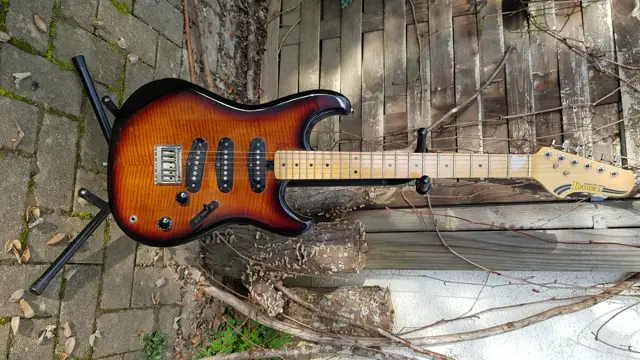
My 45-year-old Ibanez played all of that. It’s worth about one hundredth of the Bernabé. I used MIDI Guitar 3 in Reaper to convert the electric guitar into MIDI signals. From these, I created the bass with MODO Bass, the oboe in the third verse with Decent Sampler/Decent Oboe, and the synthesiser with Splice/Opia Synth Wave 1 in the final section. The electric guitar in the final chorus was processed with Bogren BDH 66o6 Plus. I did a lot of manual post-processing: removing ‘ghost notes’ – particularly on the bass – applying a noise gate to the electric guitar, and shifting many MIDI notes or altering their duration.
For the first two months, the drum and percussion part of Sade’s ‘Smooth Operator’ at https://www.youtube.com/watch?v=CTJkqlRYzbw served as the rhythm for my song; I downloaded it from YouTube as an audio file and sped it up to 136 bpm in Reaper. A Latin groove, completely dry, with no reverb. I recorded all the classical guitar parts and the German vocals to go with it. In https://www.youtube.com/watch?v=oFHLsPumPCM it was wonderful to see – with five cameras – which beat occurs on which drum part and when. I kept checking there whenever I was unsure. The basis of my song’s rhythm was bossa nova.
All the rhythm instruments had to be programmed as MIDI notes in Reaper. I first tried to do this using ReaSamploMatic5000, which comes with Reaper. I spent many hours searching the internet for suitable sounds for individual instruments. It took me ages to tune the bongo sounds to the correct pitches and compare them. The result was rhythmically and melodically correct, but it sounded awful. Then I tried MODO Drum, which cost €50. A drum kit where all the parts fit together well. But I still much preferred the ‘stolen’ Sade sound. Finally, I bought EZDrummer for €219 and picked everything together from four drum kits. Hi-hat, kick, and cymbal from the TightR kit, the toms from MainR, snare and side stick from Jazz, and from the percussion kit two congas, two bongos, and chimes in the finale, for the shower of petals. Now I was finally satisfied.
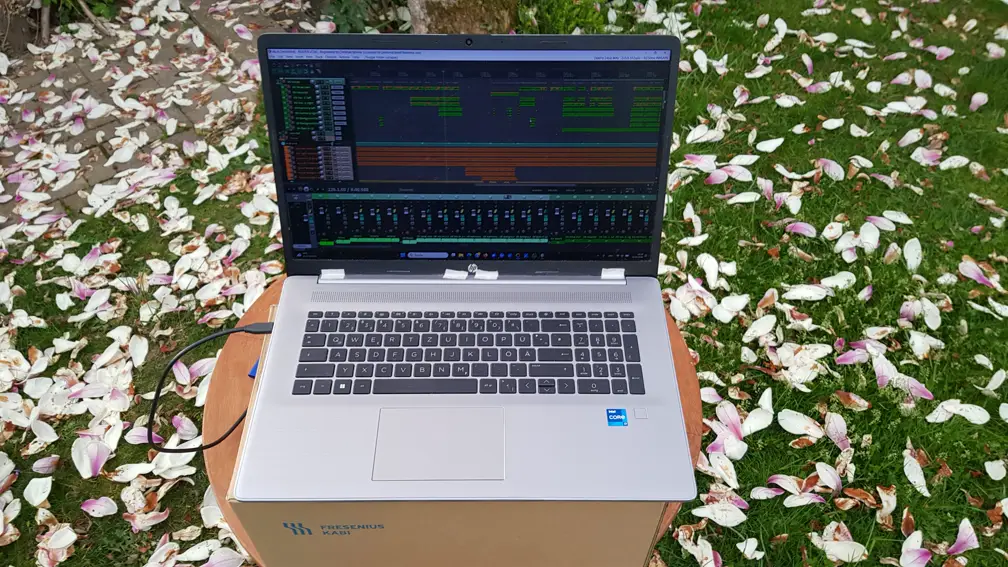
DAW stands for Digital Audio Workstation. At first, I fancied recording the song using Audacity. I’d used it for something decades ago. But if you want to make anything of your song, you need a DAW, and you’re spoilt for choice. Before I recorded the first note, I spent a month watching YouTube videos. First, to choose a DAW, then for the first steps in Reaper. My song has 57 tracks, many of them just for short effects. 9 tracks of German vocals, 9 of English. Each in its own bus, so I can mute them with a single click. In the image above, you can see the guitar and vocal tracks. There’s a main project and a master project for the final mastering. Unlike graphics programmes, you can easily manage an audio project like this on a standard laptop. Every now and then, freeze rendered plug-in tracks that use a lot of memory, and always keep things tidy.
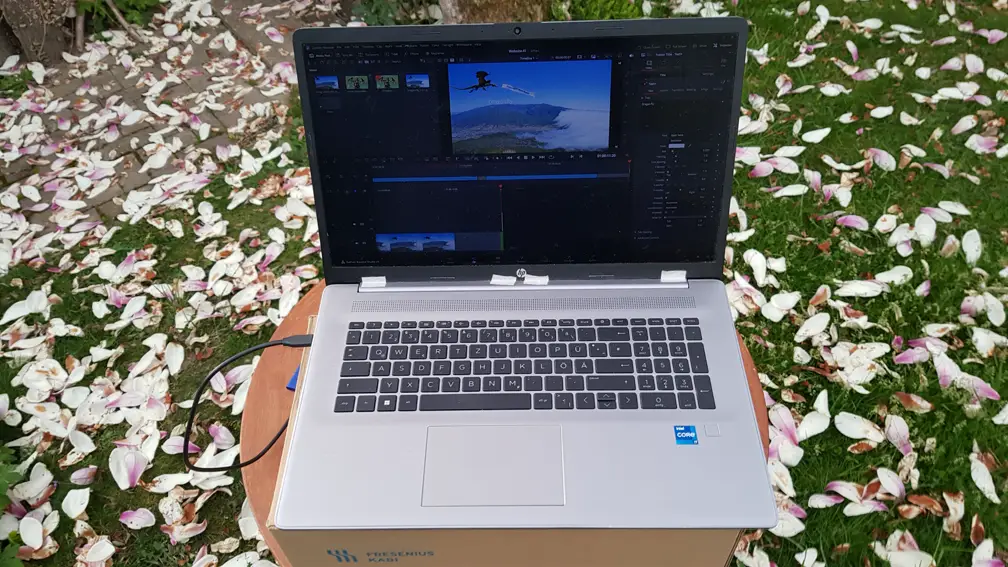
Unlike AI graphics programmes, where you generate new images or video clips using text prompts and the results are usually highly dependent on chance, DaVinci is like a graphics surgery kit that allowed me to control image sequences down to the 30th of a second and precisely manage complex effects. The results here are never random. However, AI does play a role here too: you can use it to improve the quality of old videos or utilise the Magic Mask, which became my favourite tool. This allows you to cut objects out of video clips and insert them into other clips. However, a computer with a graphics processing unit is strongly recommended. My laptop doesn’t have one. I created all the computationally intensive effects in 60 pre-projects; in some cases I had pre-pre-pre-projects and often faced endless waiting times. I saved the results as ProRes files in the highest quality, which are huge but easy to process. Nevertheless, I had to split my main project, running at 30 fps, into two parts for the 6-minute duration. I bought a fast 1.7 TB SSD for 200 euros. As in Reaper, I had German and English audio and text tracks in the main projects, with one language muted at a time. The audio tracks came directly from Reaper.
I picked out the wind sounds for the beginning and end of the song right at the start. There are plenty of websites for that sort of thing. You can get a lot of it for free, and I also bought a few things for just a few euros. But I didn’t end up using much of it. It’s also important not to cut corners in the wrong places. I bought decent microphone stands and cables. Using Shutter Encoder, I’ve resized countless videos and images, e.g. all the images for this website to a maximum of 150 KB in webp format, usually much smaller. And with such great little tools, I’ve even voluntarily donated 10 euros or so.
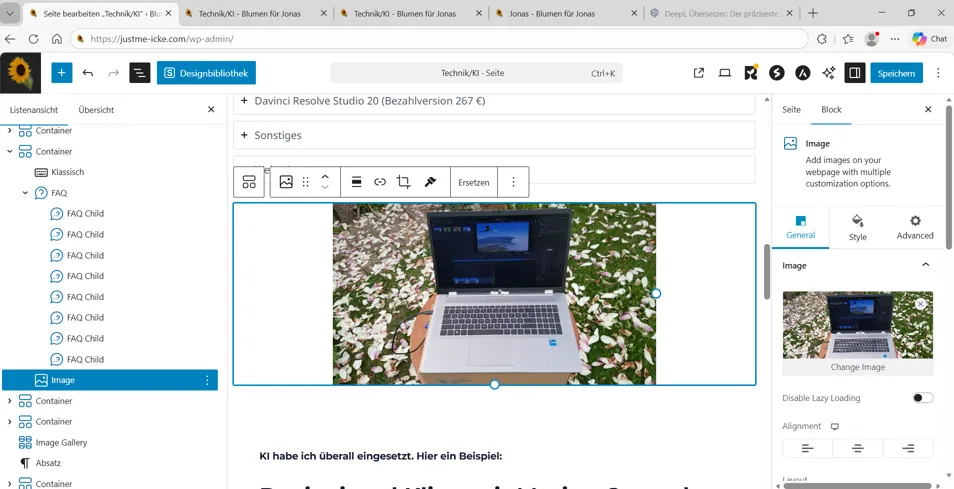
I created this website using WordPress, the Gutenberg editor, the Astra and Spectra themes, and the Outdoor Adventure template. I also used Polylang for multilingual support. Why? I thought: what if I’m asked a thousand questions and don’t have time to answer them? Should I simply not reply, even though I’m so keen to raise awareness of the difficult topic of ME/CFS? This website is designed to answer as many questions as possible, so that I can simply refer people to it. And if nobody asks, well, then the effort was just for nothing.
Artificial intelligence
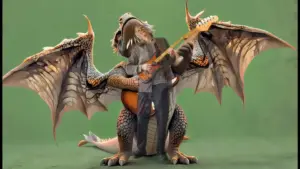
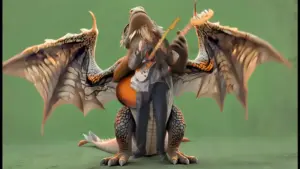
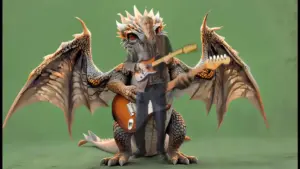
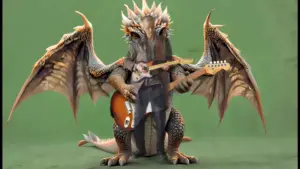
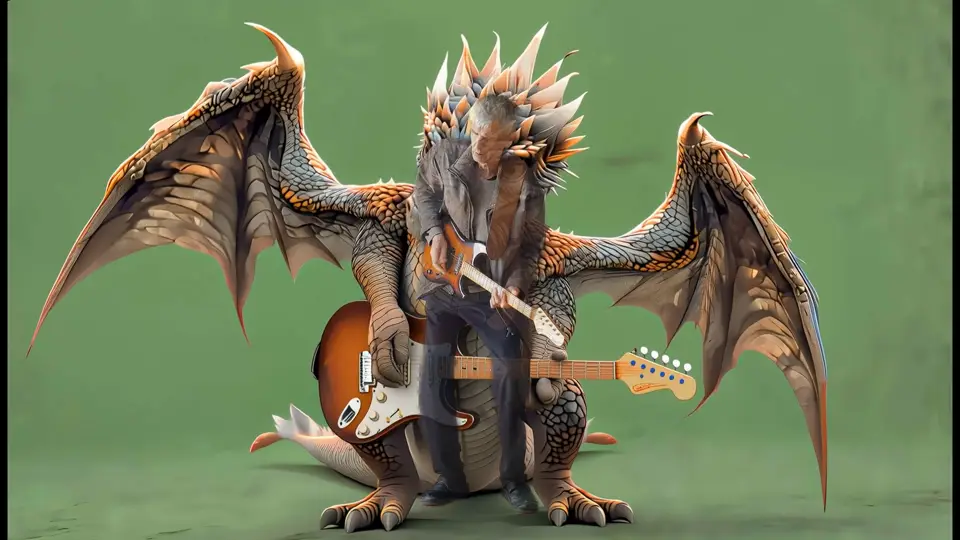
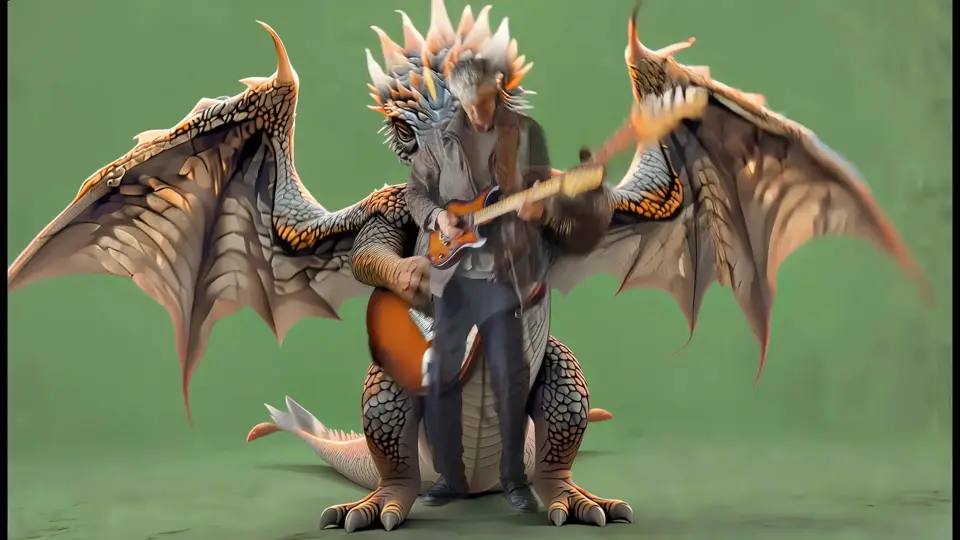
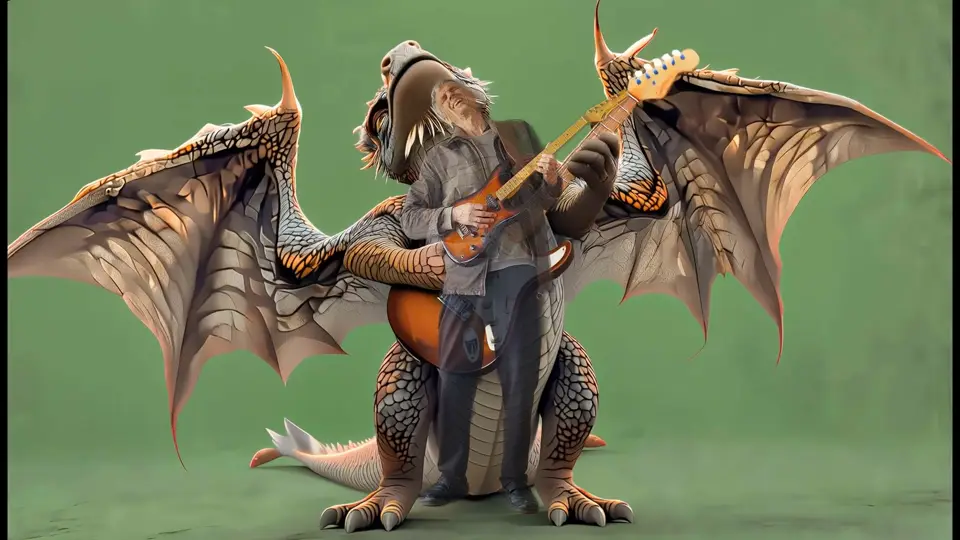
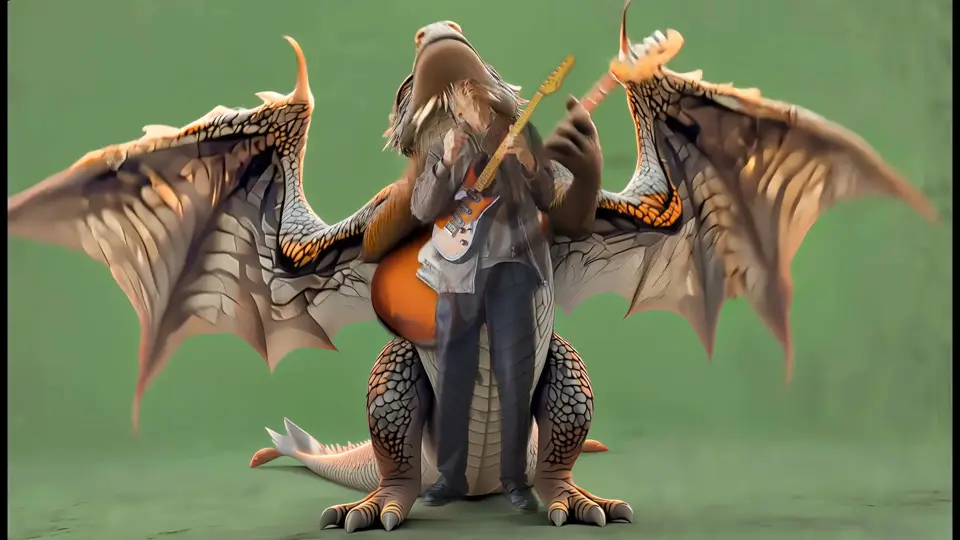
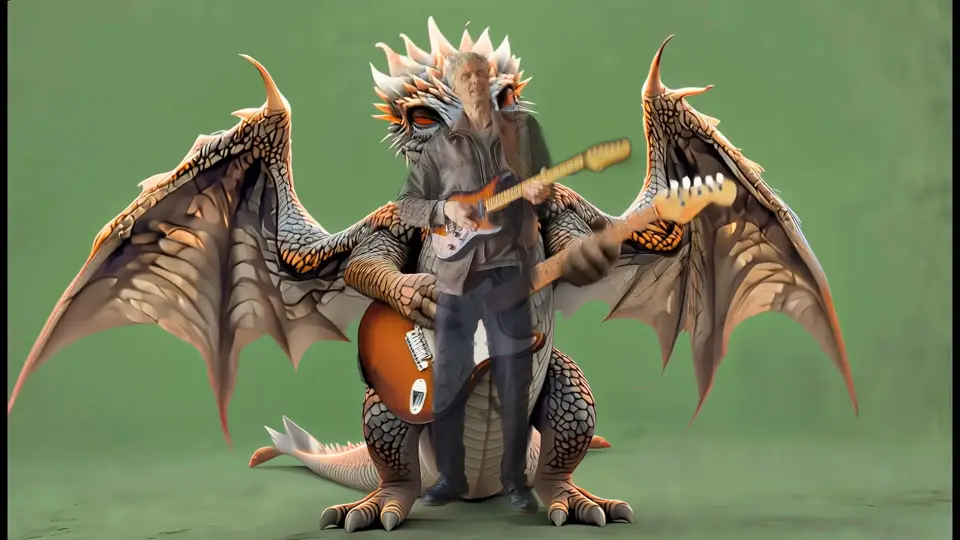
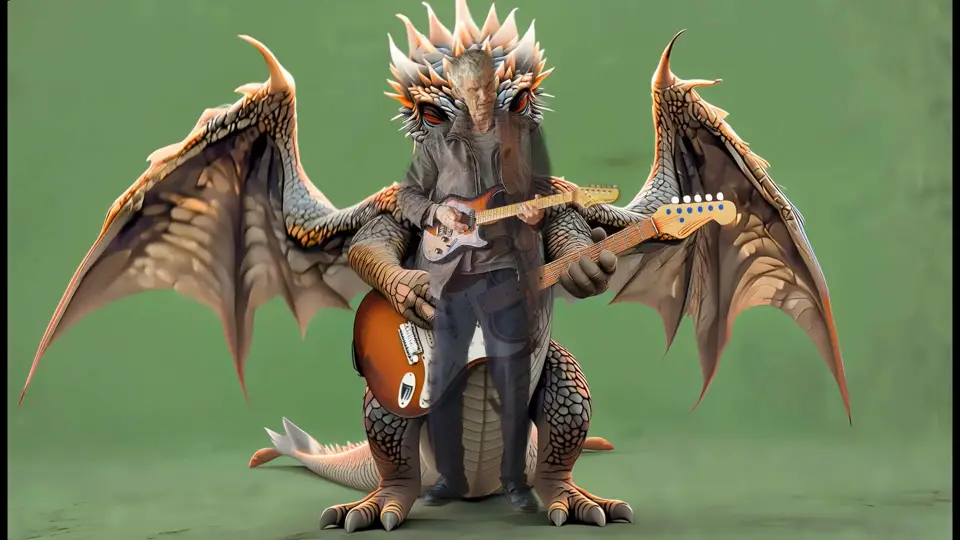
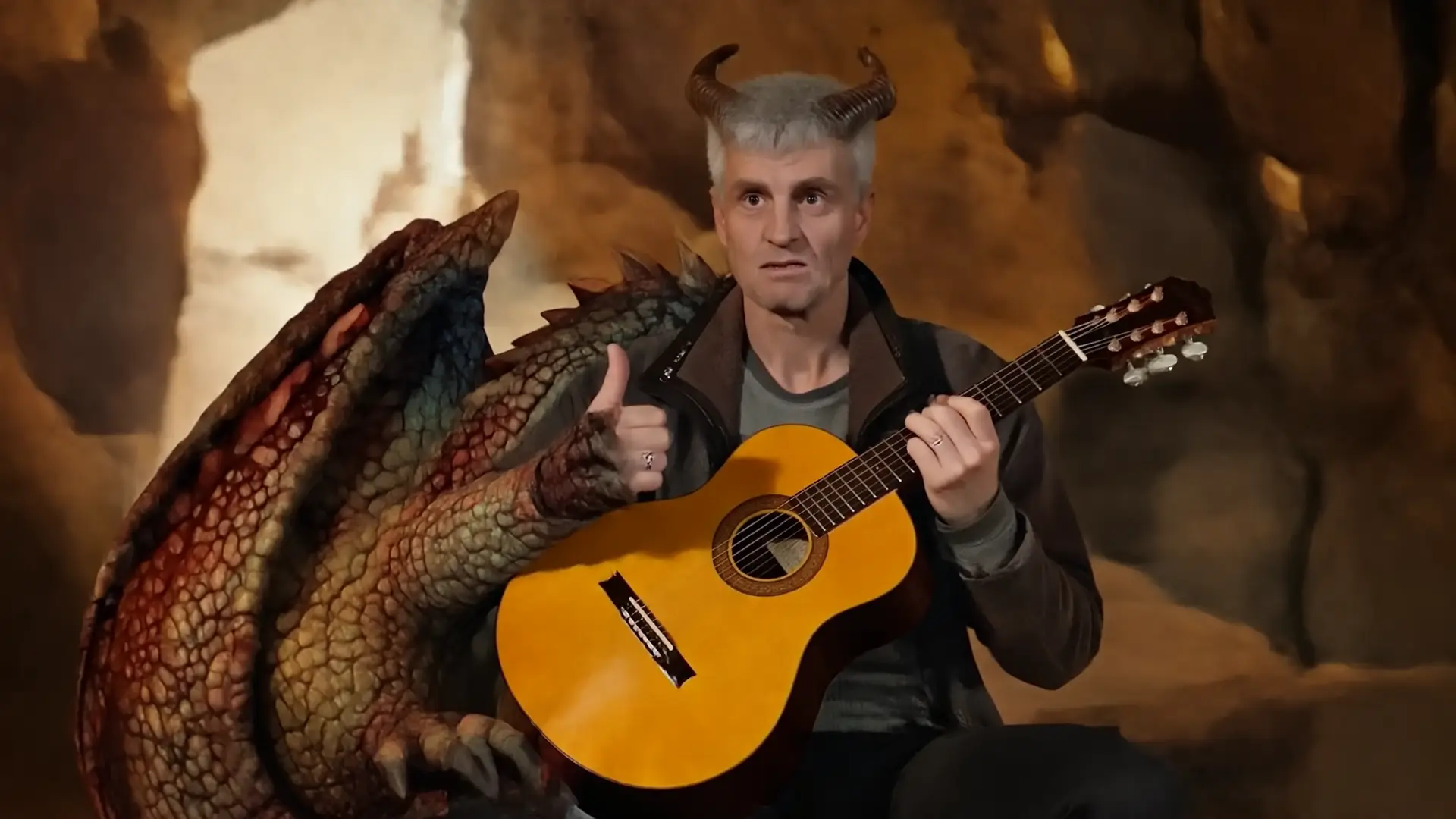
And that’s how I ended up becoming an actor too. A completely new role for me. I filmed myself playing the electric guitar part, and Kling AI then transferred that – including my facial expressions – onto Dragomir. But getting an electric guitar into his hands and positioning him correctly took a while too. I used this technique a lot in the video.
Without AI, I would never have started this project.
I use AI as if I had a friend living here. No, lots of them. They’re all specialists with exceptional talents. They know everything there is to know about their subjects, but sometimes they get the simplest things mixed up. Or they give detailed instructions, but unfortunately have an older version of the programme in their heads. You realise this quickly and ask again. And then, hopefully, you find out how to do it according to the latest manual. – Sometimes, though, it’s better to give up and do it a different way somehow:





I have used AI in
• Audio: Audimee running in the background for a few seconds, my own voice an octave lower. The song is otherwise AI-free.
• Research and technical support for all technical issues
• Video: Kling AI and Runway for fictional and re-enacted scenes (Pro subscriptions for €36 and €33 per month), DaVinci AI features
• English text: Google, ChatGPT, Claude + DeepL. They went back and forth checking my suggestions and their own for three days until it felt right to me. But I always came up with the key ideas myself – Just ME, really.
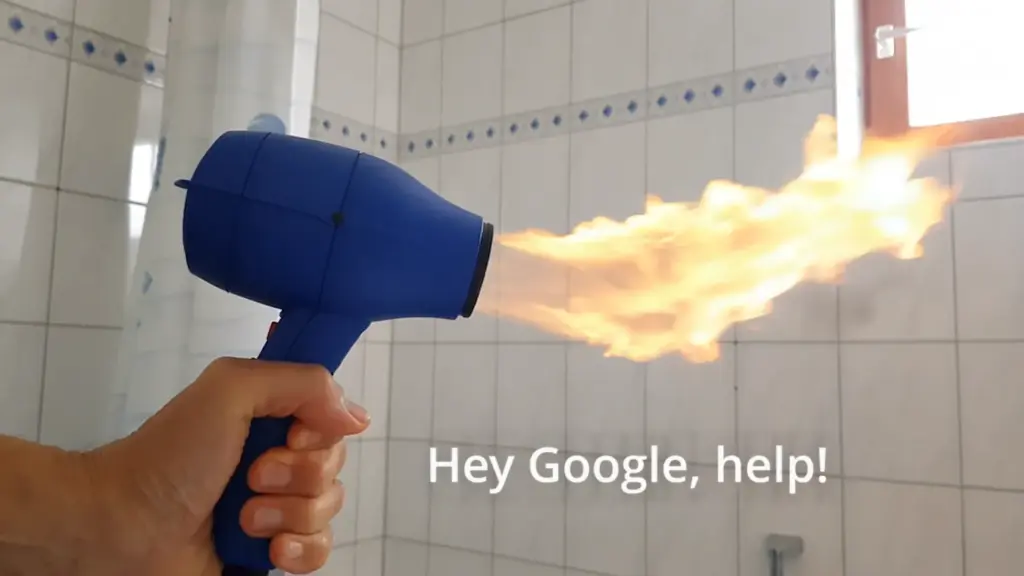
Imagine your hair dryer suddenly catches fire and you ask in horror, “Hey Google, what should I do now?” (Scene from the “making-of” video for “Flowers for Jonas,” released in July 2026)
AI Video Disclosure – where?
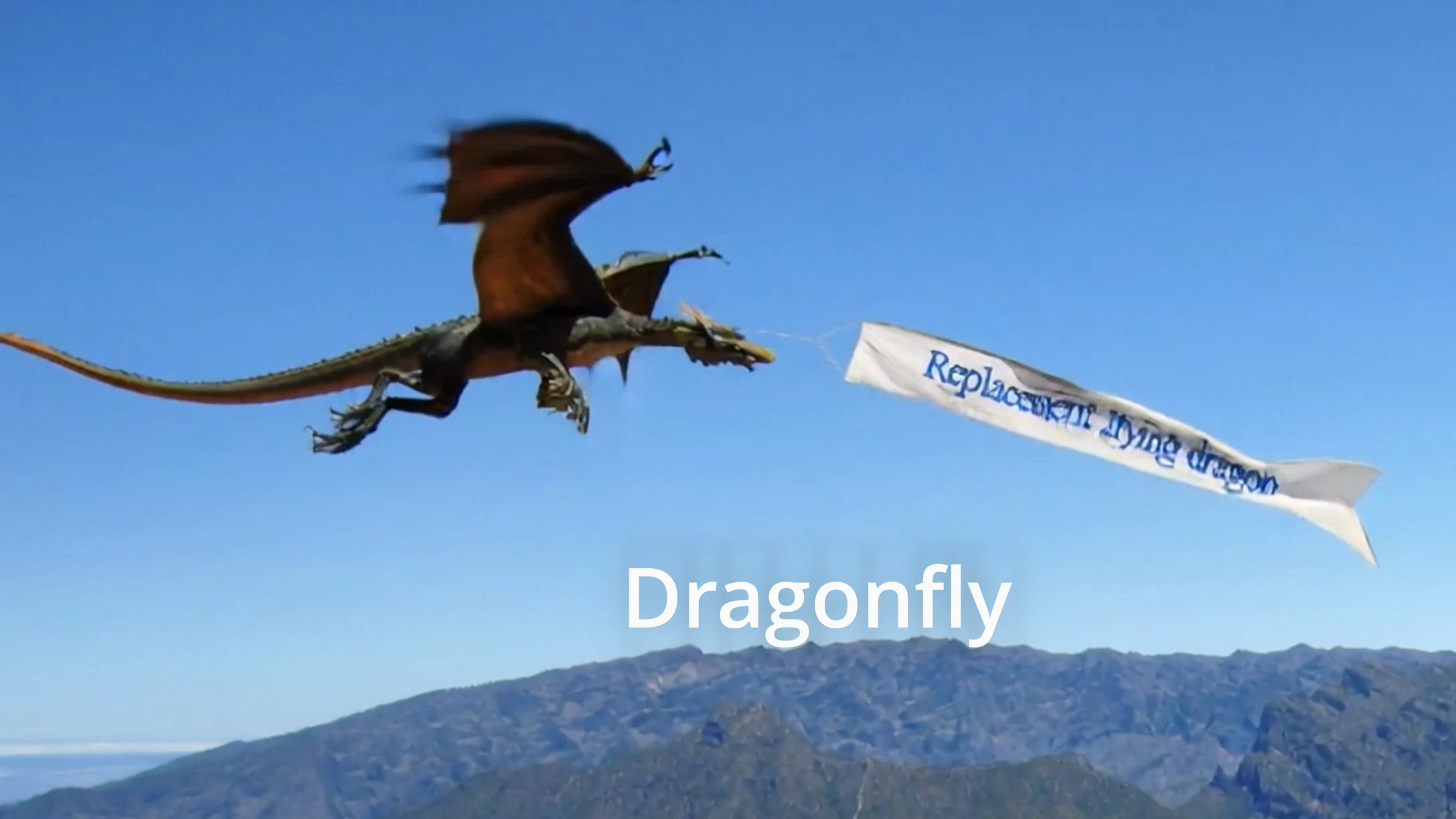
One major risk with AI is that you can no longer tell reality from fiction. It’s tricky. Almost all the photos were taken by me – Just ME – and appear in the video without any AI editing. Even the videos I filmed myself haven’t been altered by AI, apart from a few ‘minor tweaks’. Things like, for example, adding a tiny dragonfly to the picture, just for a laugh. Or what I describe below at the 00:20 mark. Some opening shots from AI-generated video clips are also real photos. Here are all the scenes that have been edited with AI, along with explanations of a few others.
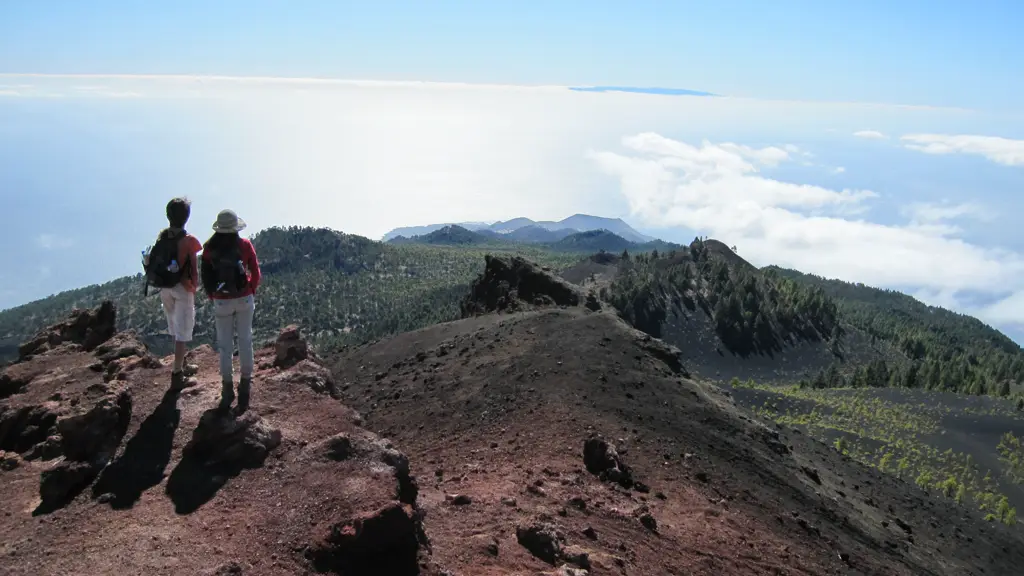
Video link 00:00: Andrea and Jonas are looking out over the southern tip of La Palma, across the sea towards El Hierro. I created the next 20 seconds using Runway. You can find out why a dragon suddenly appears there on JustMe/Dragos.
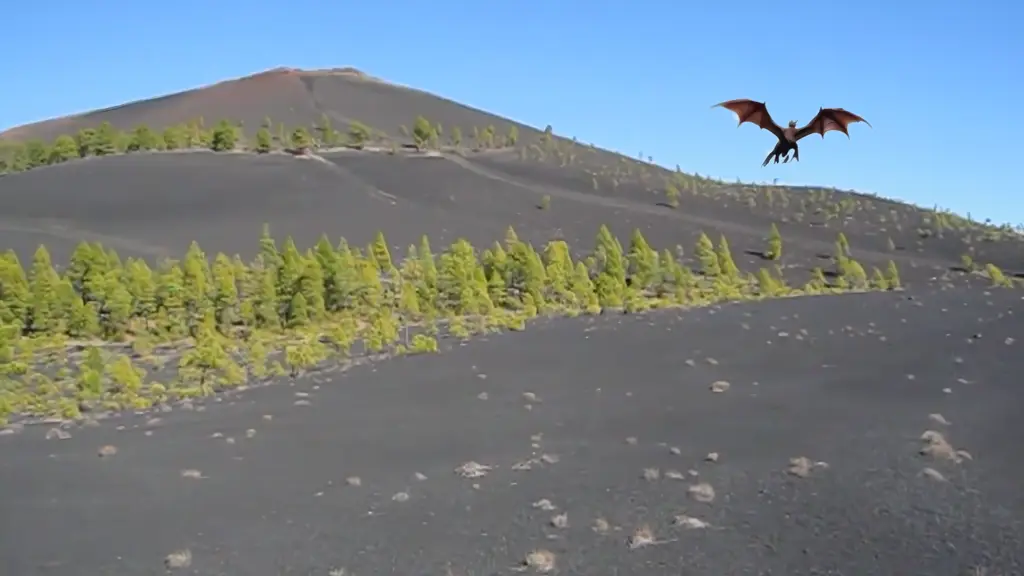
Video link 00:20 – The dragon was created in Runway, cut out using the Magic Mask in DaVinci Resolve, and inserted here. Nothing else has been changed. What was Julian looking around for shortly afterwards? Perhaps it really was a dragon after all? Who knows. – The whole thing doesn’t look professional. I tried to create another dragon flight but then gave up. There was too much else to do. Since everyone knows that dragons don’t exist, it’s clearly recognisable as artificial. This is ‘art’ – in the truest sense of the word – and therefore needs no extra explanation.
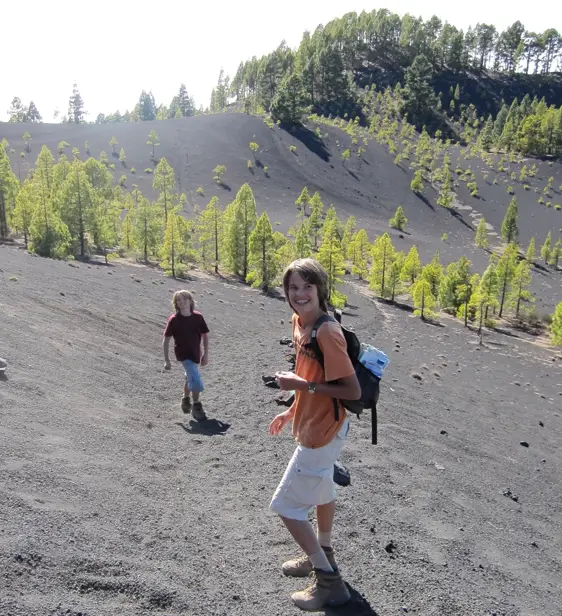
Video link 00:30: Das ist die einzige Szene, wo ich von meinen Prinzipien, die Originale nicht zu verändern, abgewichen bin: Das Foto ist original so entstanden. Danach machte ich damals weitere Fotos und dann noch kurz ein Video. Aber da waren die beiden schon ganz unten und eine Staubwolke hing noch hinter ihnen. Das konnte ich nicht nehmen. Und mit Einsatz des Rhythmus passt dieser schnelle Lauf einfach perfekt! Ich gab Kling AI Startbild und Endbild vor und machte unzählige Versuche, bis es mir halbwegs gefiel. Das war noch viel komplizierter, ich musste es in zwei Teile schneiden, das führt hier zu weit. Aber ich schwöre: Genau so sind sie damals da runtergestürmt!
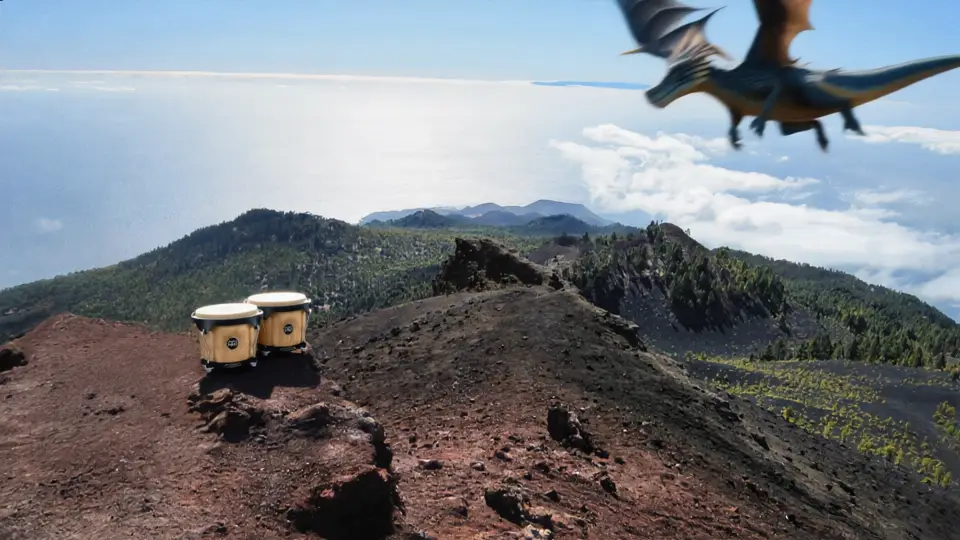
Video link 00:39: The background is the opening frame of the video (00:00). I used Kling AI to send Andrea and Jonas out and had Dragoblew fly in. It took ages, not least to sync Dragoblew’s five beats to the song with 30th-of-a-second precision. But those aren’t bongos you hear in the song, are they? Correct, those are the toms. BUT: I specifically added five bongo beats in parallel for this reason (MIDI notes from EZDrummer, Percussion set in Reaper). They’re there, even if they can’t be heard over the loud toms. Further details on Dragoblew at Just ME/Dragos.
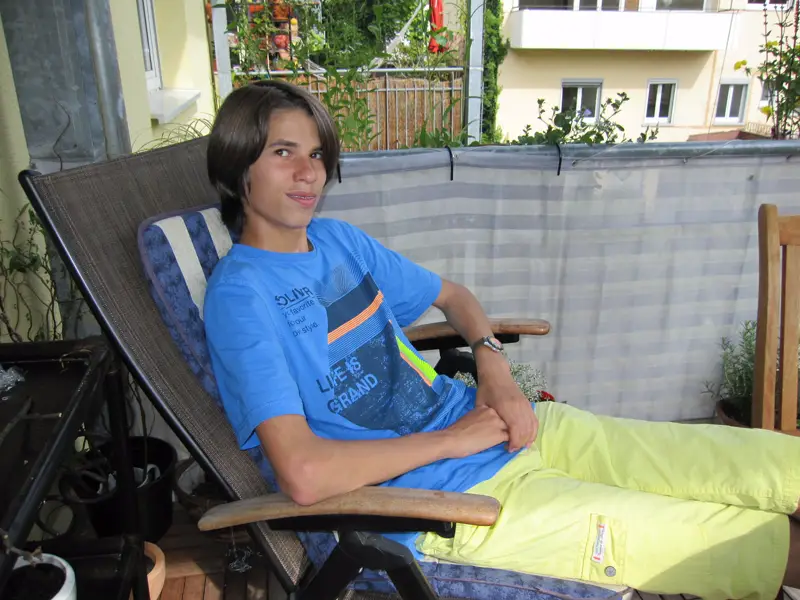
Video link 00:46: Nothing in the first verse has been altered using AI. I took the four photos at the start in quick succession on 20 June 2013. The one on the swing afterwards too. All the photos have simply been ‘cut’ and ‘animated’. Fly-ins, zooms and so on are simple standard functions in DaVinci Resolve. But it still takes a lot of time to get it to match the music. Especially for me as a beginner when it comes to video editing.
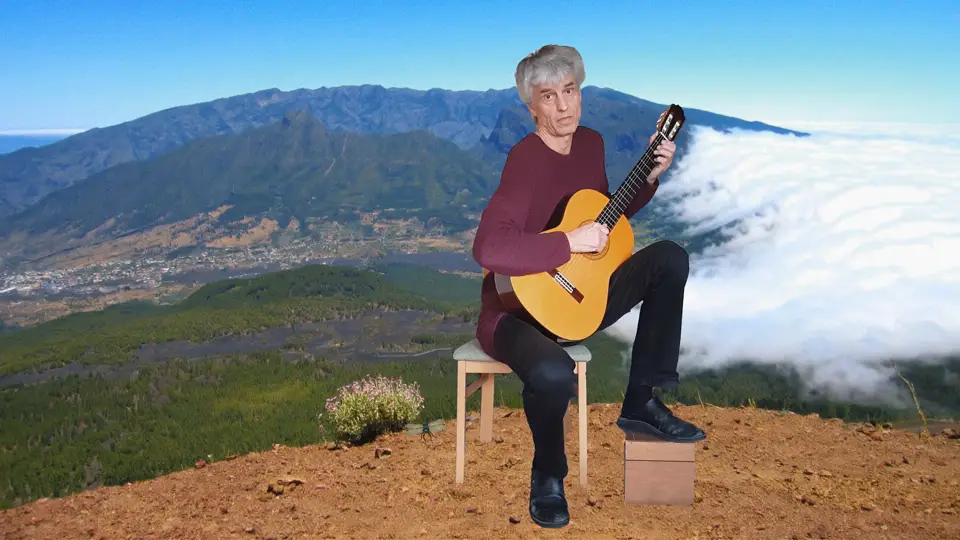
Video link 01:21: This is just a placeholder because there’s no text (apart from “no, never”). I simply cut out Just ME using the Magic Mask tool in DaVinci. I animated the original image in Kling AI so that the clouds drift by. It looked exactly like this in the original – and was even more impressive up close. Like a cascade of clouds dissolving into nothingness. I could watch that for hours. In reality, I would have sat the other way round to enjoy the view.
And yes, it doesn’t look like a real recording, nor is it meant to. It’s just a bit of fun. I didn’t have time to add a shadow to make it look more realistic. Of course, I played that part myself during the recording, with the song playing in the background at 136 bpm. Getting the clouds to move and synchronising the mouth movements precisely with the music – all that was fiddly enough.
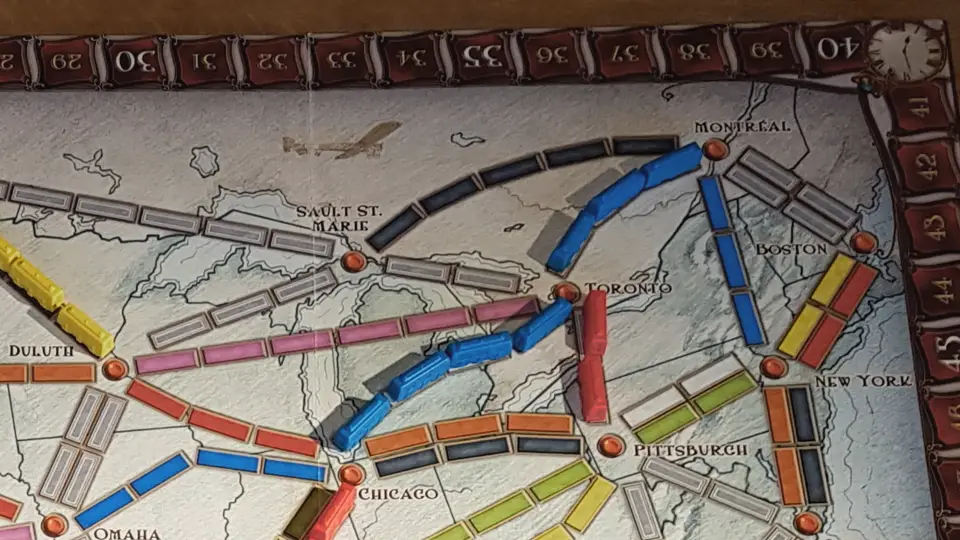
Video link 01:35: Real-life starting image provided and generated in Kling AI. – Alongside music and hiking on islands whilst on holiday, board games are my biggest hobby. They’re also what I’ve spent most of my life doing, apart from work and sleep. I’ve passed this on to my sons. Blue is always my colour. I’m teasing Julian here with yellow. Unfortunately, we have virtually no photos from our many hours spent playing. That’s why I set up the board especially for these scenes. Julian and I still play Ticket to Ride often today, especially his own ‘Lord of the Rings’ version of it.
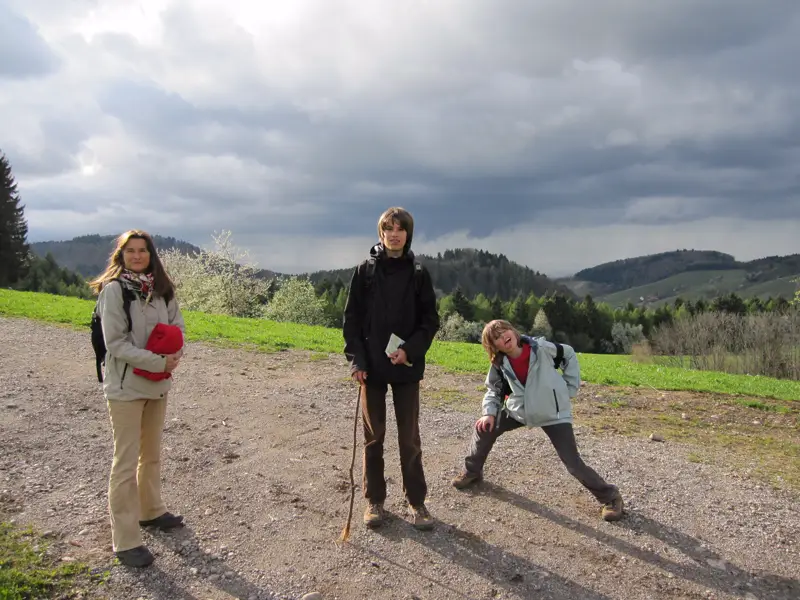
Video link 01:46: On a hike near Freiburg. Julian really does look like that – there’s no editing involved. I cut the three of them out using the Magic Mask in DaVinci. Then I danced the samba through the garden. After fiddling around in Runway for hours, I’d attached bongos to Dragomir. He was supposed to walk across the frame drumming and dancing the samba. But Runway was completely useless for that. In Kling AI with Motion Control, Dragomir perfectly mimicked my movements, but threw both bongos away in the first tenth of a second. I practised for hours looking for an alternative and beat imaginary bongos out of time. It didn’t work. So he walks through the frame without bongos. Bear and unicorn (why? See right at the bottom in Lyrics): In Kling AI, the dragon’s movement was pre-set for two further individual video clips. That’s why they’re all in time with the beat. Then in DaVinci, I cut them all out individually using Magic Mask and layered the five planes on top of one another. Drag-O-Flynn was in there at first too, but I threw him out again – it was too much. I spent a whole weekend on it.
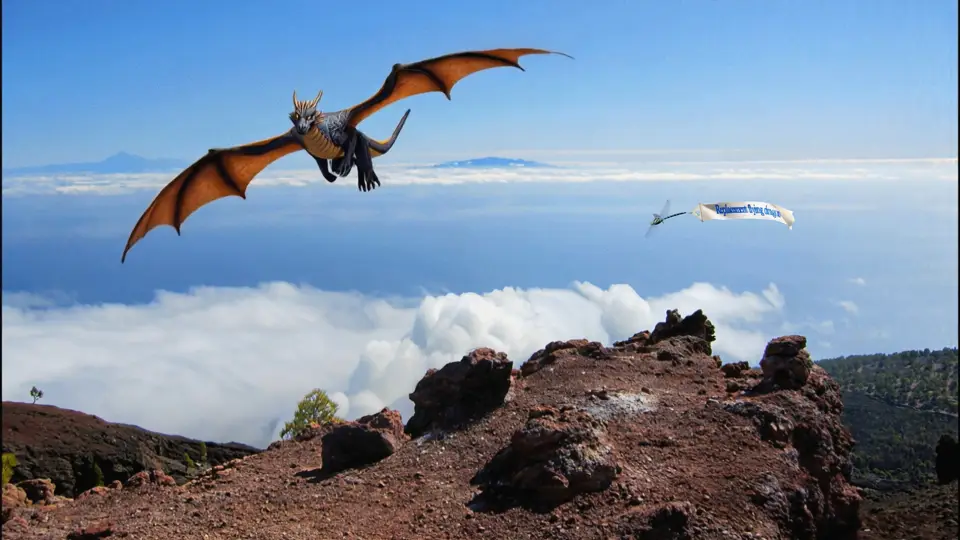
Video link 02:37: I removed Jonas and Andrea from the original image using Kling AI. Getting DragoMa into the shot and making it fly towards the camera in a believable way was much more labour-intensive than I’d anticipated. I cut it out from another video clip using Magic Mask, going back and forth several times between Kling AI and DaVinci. Eventually, I provided Kling AI with both the start and end frames (see photo above). I wasn’t satisfied with the result until DragoMa was casting a shadow and I could also make the clouds drift using Kling AI. I cut out the drifting clouds again with Magic Mask and placed them over the background. Unfortunately, AI video programmes often alter things that are meant to stay the same or degrade the quality. More on Drag-O-Flynn at the very bottom. And on JustMe/Dragos.
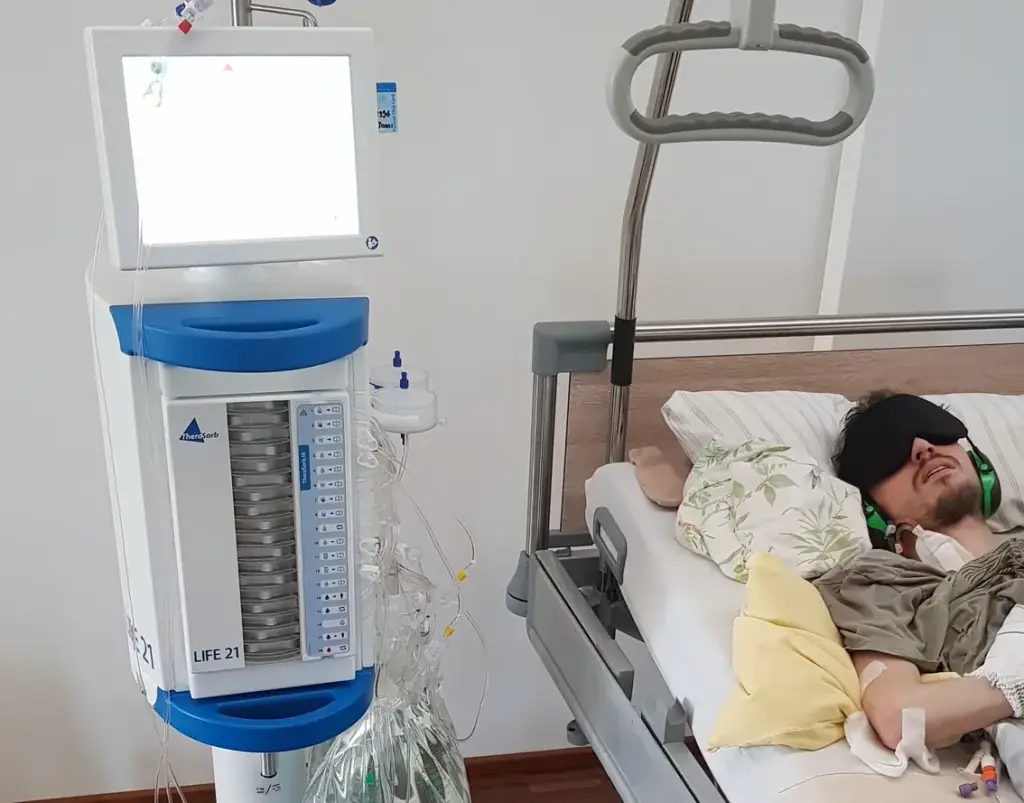
Video link 03:09: It took a whole year of overcoming obstacles before Jonas could receive immunoadsorption. It worked out thanks to our brilliant health insurance provider mkk in Berlin! – This video clip contains no fictional elements whatsoever. However, it is a good example of how to take a shaky 9:16 portrait-oriented video and, using stabilisation in DaVinci Resolve, turn it into a small 16:9 clip that is stable enough to be usable. This is an ‘AI function’ that kept my underpowered laptop busy for hours, but not in the sense of an AI video programme like Kling or Runway. Nothing is invented; instead, the images are shifted so that they fit together without shaking. – But that isn’t always possible. I wanted to use video clips that I’d given up on after trying for ages. The quality was simply too poor.
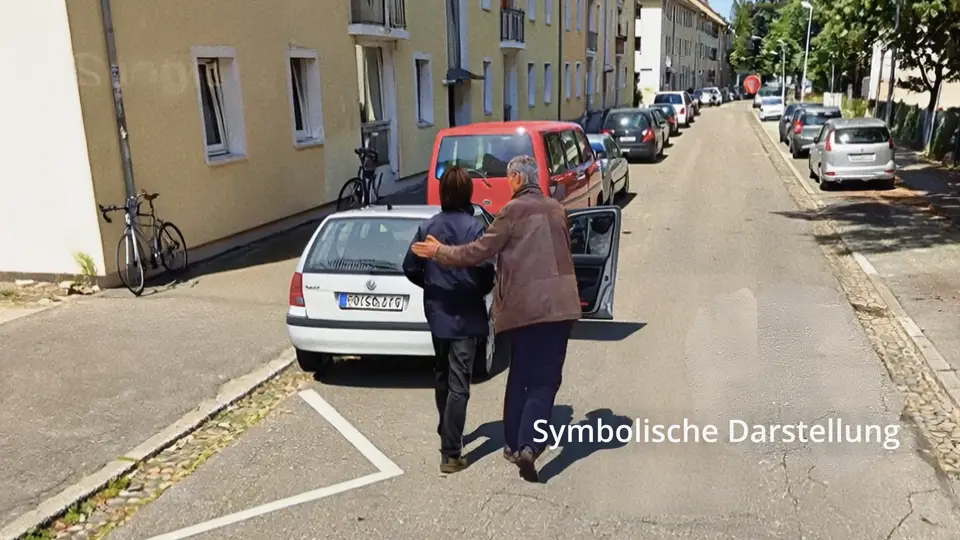
Videolink 03:51: Actually, the whole hospital section was supposed to be in comic-book style, to make it absolutely clear that it was a re-enactment. But the AI programmes wouldn’t allow it; all my attempts with ‘comic-book characters’ just looked ridiculous. I could make a whole video about that on its own…. When I’d finished the hospital section, I breathed a sigh of relief. The hardest part of my project was done. Everything here was created using Kling AI, Davinci, as well as my own re-enacted images and videos. Mostly involving several preliminary projects in Davinci, which was extremely time-consuming. To describe that in more detail would go beyond the scope of this post. I’ve labelled the whole section as a “symbolic representation”. But the scenes are all based on the reality of Jonas’s hospital stay in 2014. To achieve this, I spent ages thinking about how I could depict events that dragged on for hours or even a year in a two-second video clip, each one matching the text. I also did a lot of research on this. We had to go through some terrible experiences in 2024 as well, and today things are no better in most hospitals. With the exception of places like the BDH Clinic in Waldkirch in 2025, where the utmost consideration was given to Jonas’s symptoms. I was very grateful to the doctors and everyone else there for that. See FAQ for more…
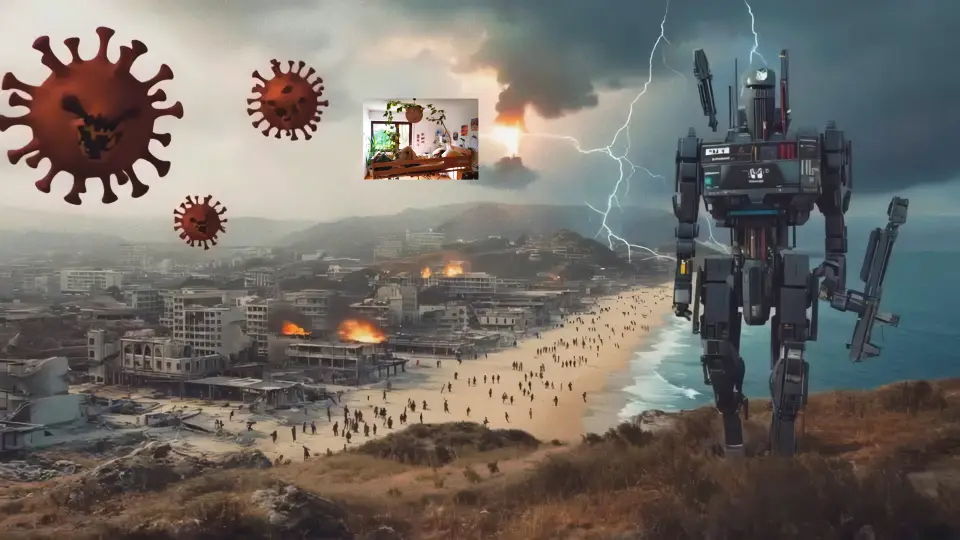
Video link 04:19: In Runway, I sketched out the image of the combat robot and the coronaviruses on a hill overlooking the burning city, with a bolt of lightning and a nuclear explosion in the background, and more besides. It came together surprisingly quickly. But creating the animation from it proved difficult. The lightning would only stay still once it was set, and whenever something turned out exactly as I wanted it, Runway would change something that had previously been perfectly balanced, to the detriment of the overall effect. I couldn’t get everything right. That’s why, for example, the people on the beach don’t move. I later added Jonas’s image in bed in DaVinci, along with the lighting effect in the picture and the speech bubble.
Through ME/CFS, our society is losing many thousands of highly committed, life-loving people whom we so desperately need to tackle many crises and problems. We miss Jonas dearly, but so does our society. That is the significance of this scene.
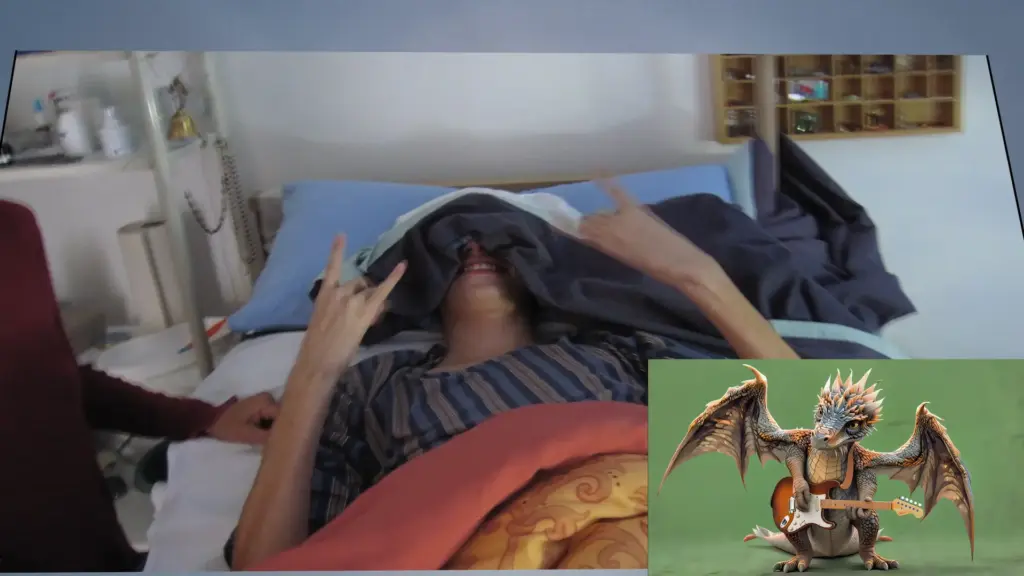
Video link 04:50: In the background, a video clip of the sun in Baden in March is playing. The photo of Jonas throwing the horns is from a time when he was feeling better than he has at any point in the last 10 years. Back then, he would sometimes rock so violently in his care bed that I worried about its stability. The animation in the photo was created in DaVinci, but calculated to the nearest 30th of a second using an Excel spreadsheet: a rocking motion that slowly comes to a halt and then tips over, always in time with the beat. I’ve already described how Dragomir became a Guitar Hero above, using a carousel of images.
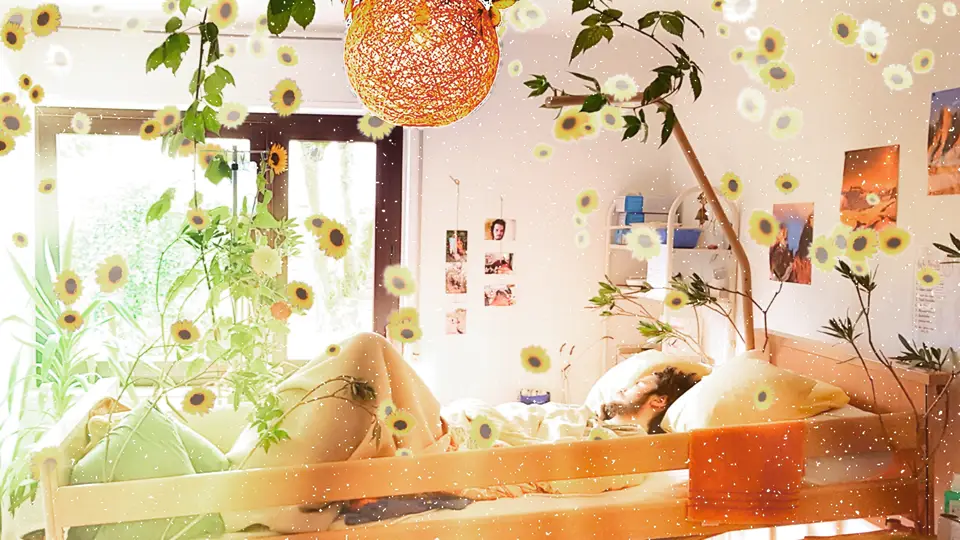
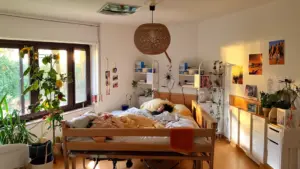
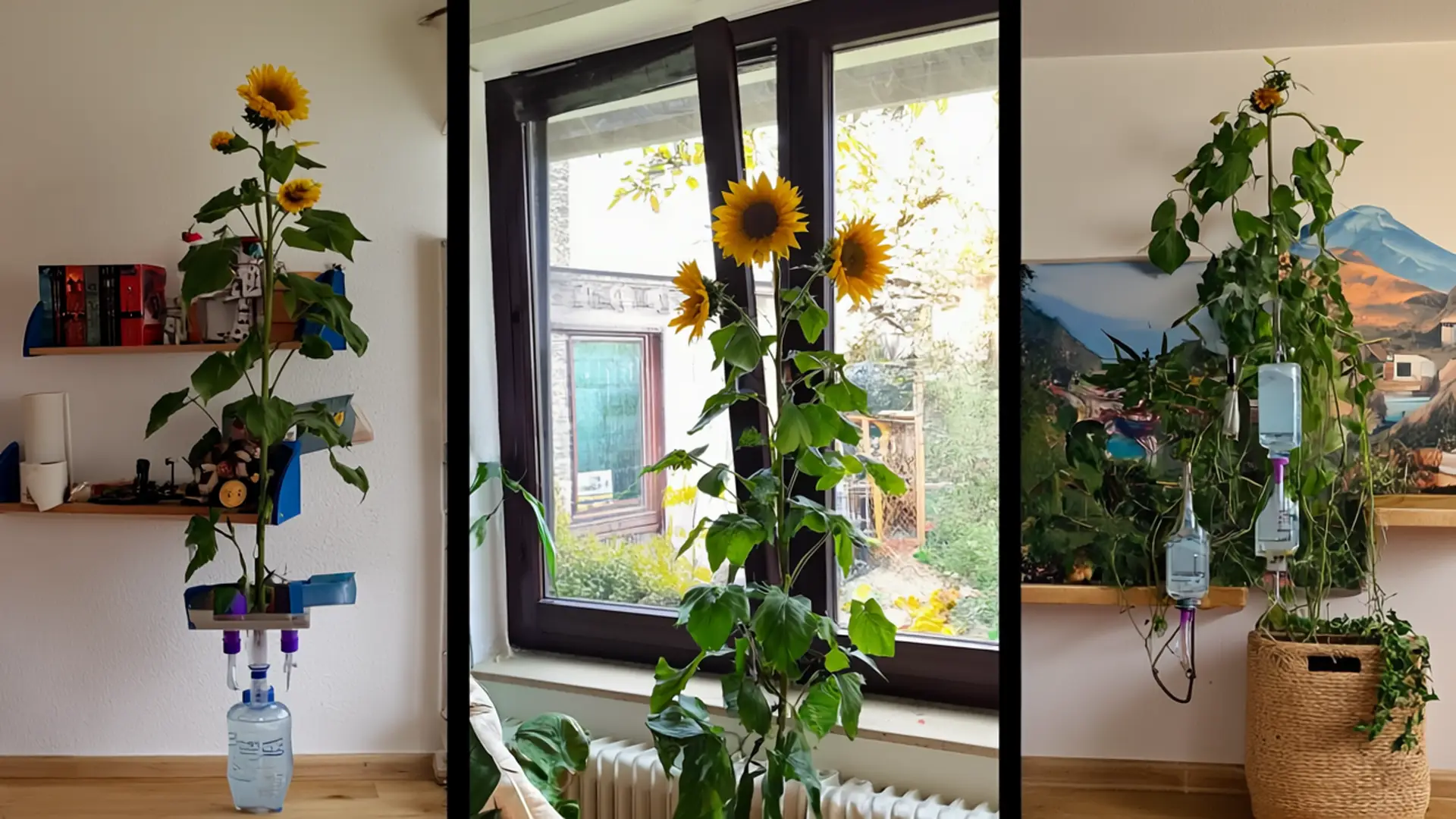
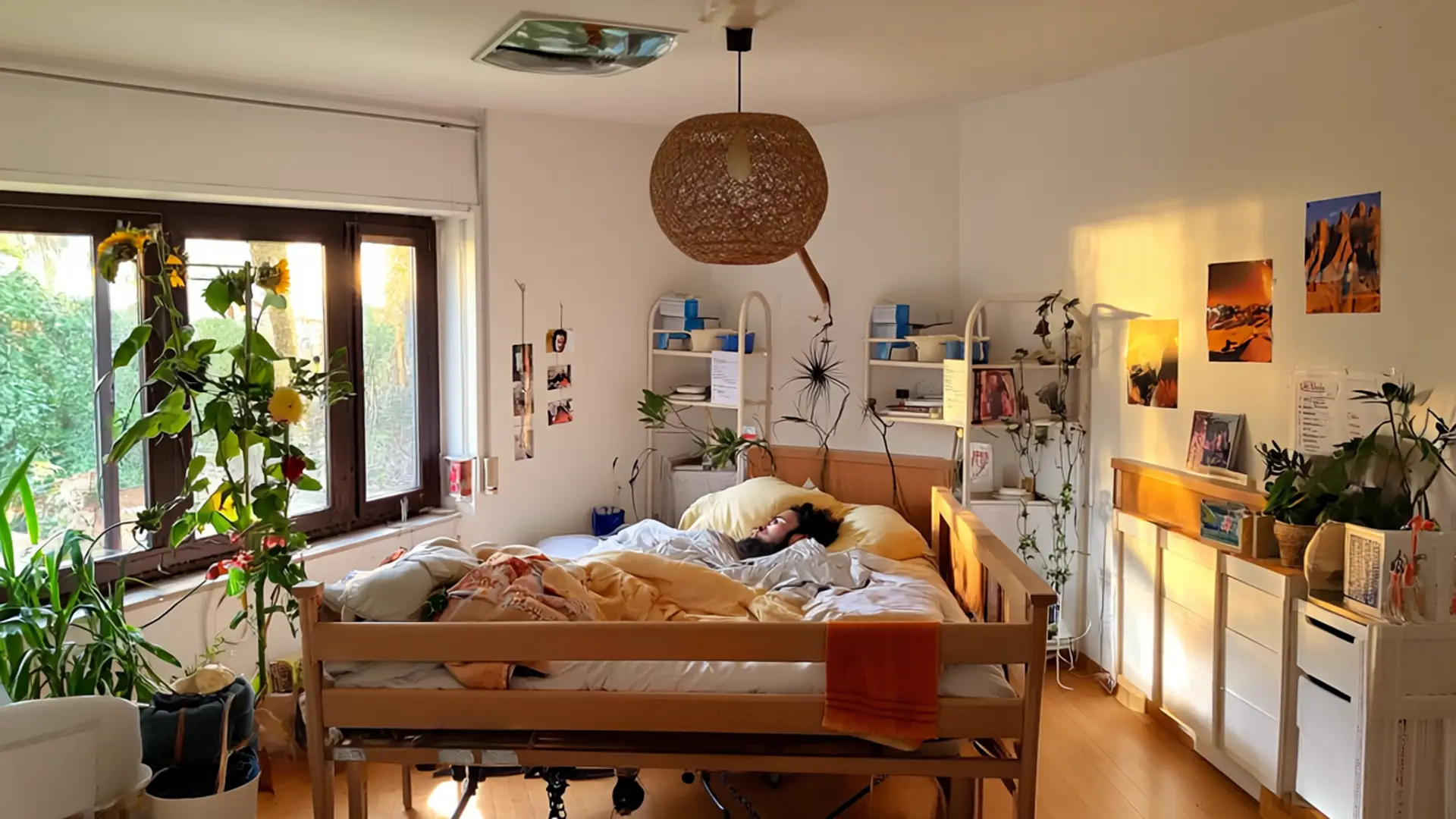
Video link 05:10: I described this scene to Kling AI in detail, exactly as it appears in the video. And I ended up with a grotesquely ridiculous pile of roses that were dumped onto Jonas from the lamp. Splash! There you have those silly flowers! So there’s no AI in this part of the video. All the effects were calculated in DaVinci. The basis is a sunflower. The one from the logo at the top, or rather the exact one blooming for Jonas in the real image above. In various sizes, rotations and variations. And in three layers, extracted using the Magic Mask, as well as various zones in the image: bedposts in the foreground, the lamp at the top, Jonas with his duvet, plants. All separate layers. Then these layers were stacked on top of one another. That’s why some sunflowers trickle down right at the front, others in the middle and some right at the back. The ones at the back are on average slightly smaller and have a ‘blur’ applied to them to create spatial depth. I animated the image beforehand in DaVinci with a glow effect, and the lamp separately. All the effects increase gradually, defined in Excel and entered manually in DaVinci. The glittering dust was created in DaVinci Fusion using six effects in succession. That took another weekend. I then incorporated the effect into the resulting video as a one-second transition, which took two hours. But that’s exactly how I wanted it! And to all the pros out there, don’t forget, I’m a bloody beginner!
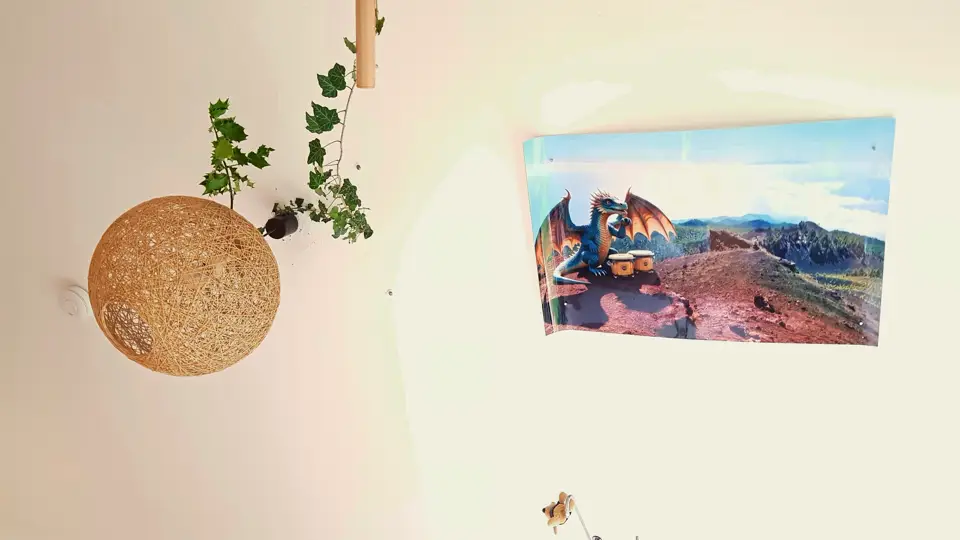
Video link 05:25: This is where fiction and reality blur – that’s the sort of thing I like. I turned this scene from the video into a poster, stuck it to the ceiling of Jonas’s room and took this photo of it. So, while there’s AI involved, the poster is now a real thing. The picture also shows just how imperfect my video is. The white colour is clipping; it’s too bright. In the end, I didn’t care – so be it. I don’t have any more time.
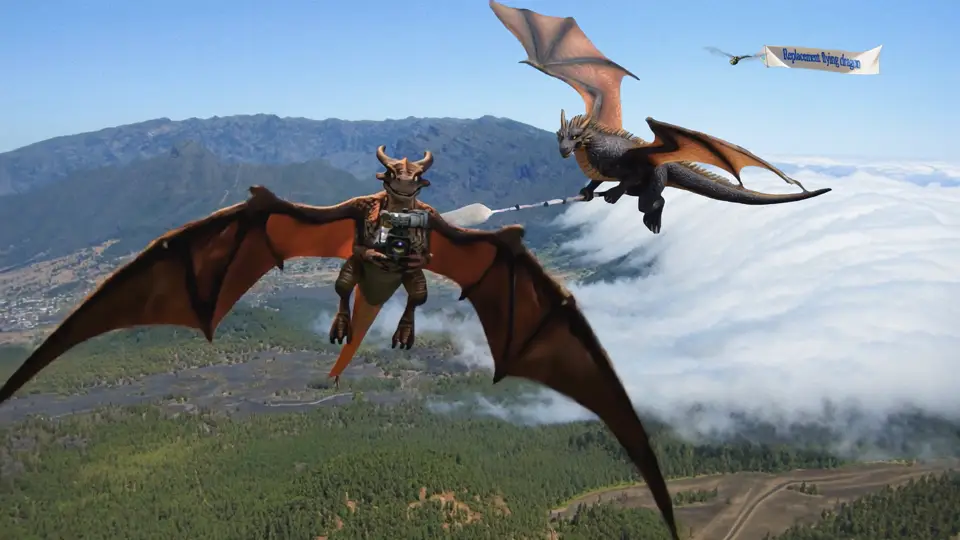
Video link 05:32: Details on the JustMe/Dragos subpage. All the dragon videos were created using Kling AI and Davinci, along with my own footage. I combined them in various ways. For the Dragoduction Team image, I ended up with 10 layers on top of one another. The final flight of the dragon rider Jonas on DragoPa was a very laborious adventure lasting a day and a half for me. That was the last real hurdle before finishing the video. I had to change my approach and faff about several times until it was just right. Not perfect – DragoPa looks like a flying pig in it – but good enough for me.

This little chap seems to pop up all over the video if you look closely. He just wants to show everyone that – even though he’s so small – he can be a fully-fledged replacement for the flying dragons when they can’t make it. After all, that’s what his English name, ‘dragonfly’, suggests. He’s as daring as his namesake Errol and probably of Irish descent too? – BUT: He’s not AI at all! Instead, he was filmed live by Jürgen Liebenstein, here on his YouTube channel: https://www.youtube.com/watch?v=V2pqL2tRAig. And featured in the video with his kind permission. Thanks! – As small as they are, AI can’t quite get the hang of how dragonflies fly. I could make a whole video about that now… Maybe someone would like to see that too?